
Gnimu PCBs
The Gnimu boards are open-hardware carriers that replace the point-to-point wiring of a hand-built device. Every board is two-layer and built for hand assembly, so it is cheap to have made and easy to solder at home.
Gnimu carrier
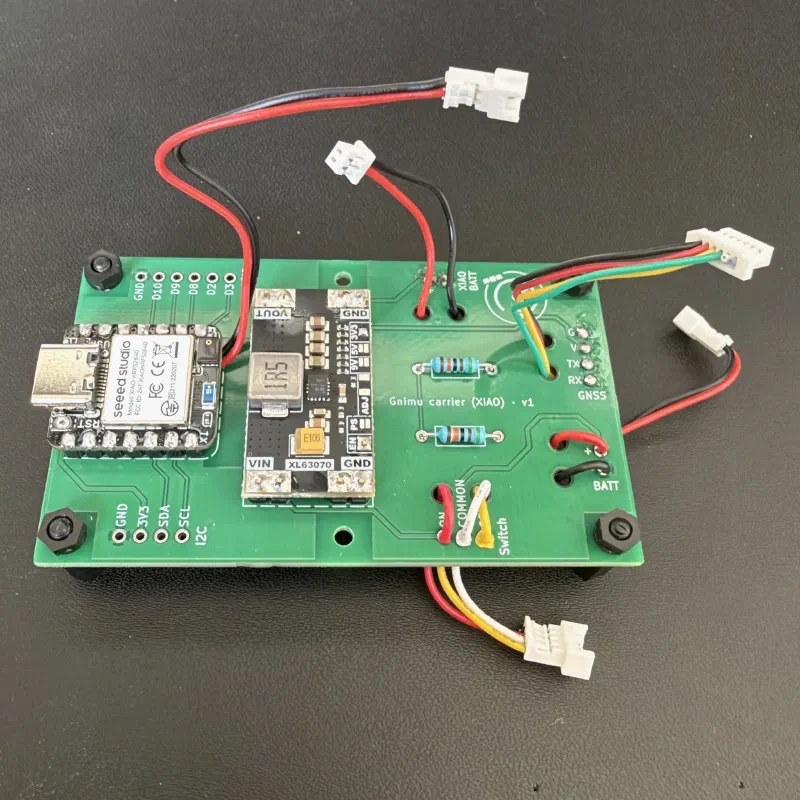
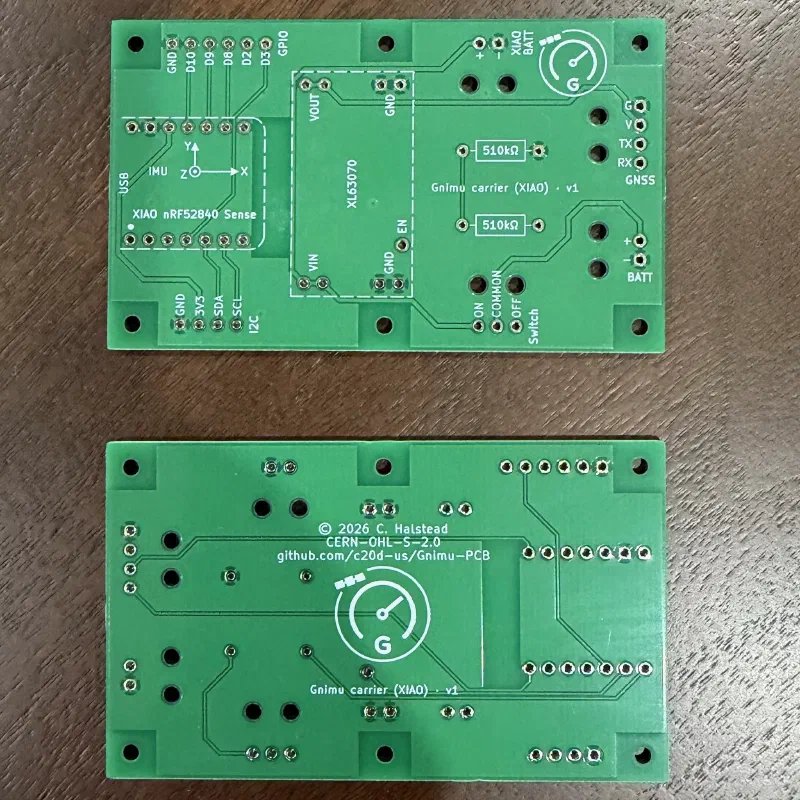
The Gnimu carrier is a small circuit board for the portable, battery-powered Gnimu build. A Seeed XIAO nRF52840 Sense and an XL63070 buck-boost module solder onto it, and labelled pads take the leads for the GNSS module, battery and switch. The connections and the firmware are the same as a hand-wired build.
Gnimu-CAN boards
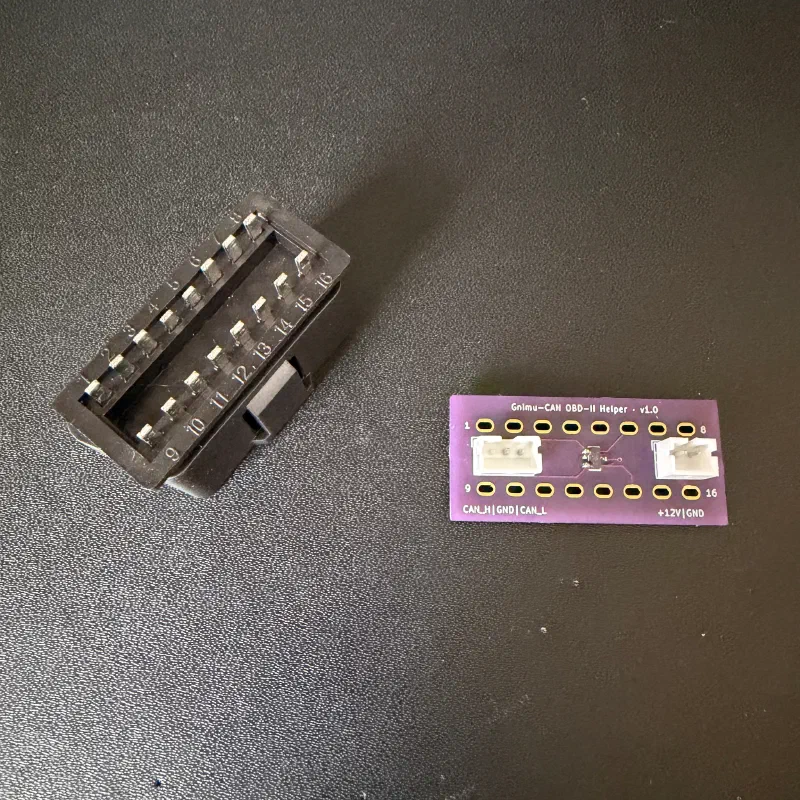
Gnimu-CAN uses two boards: a carrier for a Seeed XIAO ESP32C6 and an Adafruit CAN Pal transceiver, and an OBD-II helper that fits over the back of a straight-pin OBD-II plug and breaks out the CAN and power pins to small sockets. There are two versions of the carrier, one powered by its own LiPo battery and one by the car’s 12V supply.
Boards
| Board | Revision | Status |
|---|---|---|
| Gnimu carrier (XIAO nRF52840) | v1.1 | Current design. Gerbers not yet added. |
| Gnimu carrier (XIAO nRF52840) | v1.0 | Fabricated and built. Gerbers included. |
| Gnimu-CAN carrier, 12V (XIAO ESP32C6) | v1.0 | Ordered. Gerbers included. |
| Gnimu-CAN carrier, LiPo (XIAO ESP32C6) | v1.0 | Layout complete. Not yet ordered. |
| Gnimu-CAN OBD-II helper | v1.1 | Ordered. Gerbers included. |
| Gnimu-CAN OBD-II helper | v1.0 | Fabricated. Its 12V socket pins are reversed; use v1.1. |
The carriers are through-hole only. The OBD-II helper adds one small surface-mount part, a protection diode on the CAN lines.
The projects are KiCad 10 files, with the shared symbols and footprints included in the repository.